These Marian Apparitions Have Been Studied by Scientists
Examining Akita, Guadalupe, and Lourdes
Throughout history, millions of Christians have claimed that the Virgin Mary has appeared to them. These events—known as Marian apparitions—are often associated with messages calling people to prayer and repentance.
But beyond personal testimonies, some apparitions have drawn attention from scientists, physicians, and investigators.
In this article, we’ll examine several Marian apparitions that have been subjected to serious scientific study, including:
- Akita, Japan
- Our Lady of Guadalupe, Mexico
- Lourdes, France
As we move through these cases, the evidence becomes increasingly difficult to dismiss.
What Is a Marian Apparition?
A Marian apparition is an event in which individuals report seeing or receiving messages from the Virgin Mary.
According to Catholic teaching, these apparitions are considered private revelations, meaning they do not add to the core deposit of faith but may serve as reminders of the Gospel message.
Across many reported apparitions, several themes consistently appear:
- repentance
- prayer
- conversion
- devotion to the rosary
But the key question remains:
Are any of these events supported by evidence?
To explore that question, we begin in Japan.
The Apparitions of Akita, Japan (1973)
In 1973, something unusual began occurring in a quiet convent in Akita, Japan.
A nun named Sister Agnes Katsuko Sasagawa reported experiencing visions and messages from the Virgin Mary centered around a wooden statue of Mary located in the convent chapel.
According to Sister Agnes, Mary delivered messages calling for repentance and prayer.
One of the messages reportedly said:
“If people do not repent, the Father will inflict a great punishment on humanity. Pray the rosary every day. Pray for bishops and priests.”
But the messages were only part of the story.
The Weeping Statue
Dozens of witnesses reported seeing liquids flowing from the statue, resembling:
- tears
- sweat
- blood
These phenomena were not isolated incidents. Reports indicate the statue wept 101 times.
Samples of the mysterious substances were collected and analyzed.
A physician and professor at Akita University, Dr. A. G. Okuwa, examined the statue and gathered samples which were later studied by forensic specialist Dr. Sagisaka, who was not a Christian.
Both investigators reportedly reached the same conclusion:
The substances were human blood, sweat, and tears.
The Healing of Sister Agnes
Another remarkable aspect of the Akita events involved Sister Agnes herself.
Before the apparitions, she suffered from complete deafness.
After the events surrounding the statue, her physician confirmed that her hearing had been suddenly and inexplicably restored.
For many observers, this healing added further intrigue to the events surrounding Akita.
But the next apparition we’ll examine has physical evidence that still exists today and has been studied for centuries.
Our Lady of Guadalupe (1531)
In 1531, a recently baptized Indigenous convert named Juan Diego reported encountering the Virgin Mary on Tepeyac Hill in present-day Mexico.
The historical context was significant.
Only a decade earlier, the Spanish had conquered the Aztec Empire. Tensions between Spanish colonists and Indigenous peoples were high, and evangelization efforts faced serious cultural resistance.
During these encounters, Mary reportedly asked that a church be built on the hill.
When Juan Diego brought this request to the bishop, he was dismissed.
But according to the account, Mary offered a sign.
The Image on the Tilma
Mary instructed Juan Diego to gather flowers from the hill and place them in his tilma, a cloak made from agave fibers.
When Juan Diego opened the tilma before the bishop, the flowers fell to the ground—and an image of the Virgin Mary appeared on the fabric.
That image is now known as Our Lady of Guadalupe.
Nearly 500 years later, the tilma still exists.
Scientific Study of the Tilma
The tilma has been examined repeatedly by researchers from multiple disciplines.
Some findings remain difficult to explain.
No visible brush strokes
Investigators examining the image have reported no detectable brush strokes, making it difficult to determine how the image was produced.
Longevity of the fabric
Agave fiber typically deteriorates within a few decades.
Yet the tilma has survived nearly five centuries.
For comparison, two copies made in 1787 using the same material decomposed in less than ten years.
Survival in harsh conditions
For more than a century, the tilma was displayed:
- in open air
- in a humid climate
- near candles
- exposed to frequent touching by pilgrims
Despite this, the fabric showed no significant deterioration.
Nitric acid incident
In 1795, nitric acid was accidentally spilled on the tilma.
Nitric acid is capable of dissolving metals.
Yet the tilma suffered no lasting damage.
Reflections in the eyes
Ophthalmologists studying the image have reported that the eyes of the figure appear to reflect light in a way consistent with real human eyes.
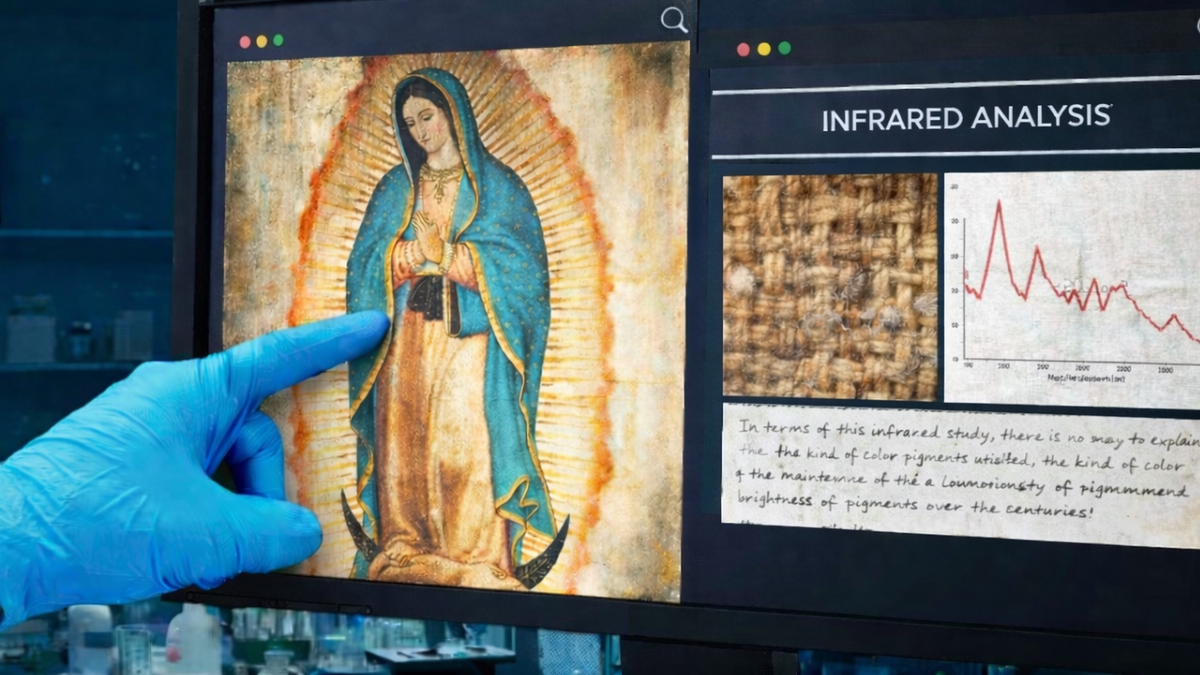
Infrared Analysis
Biophysicist Dr. Philip Callahan of the University of Florida conducted infrared studies of the tilma.
He concluded:
“The original figure is inexplicable. There is no way to explain either the kind of color pigments utilized or the maintenance of luminosity and brightness of the pigments over the centuries.”
Many investigators have studied the tilma, including:
- biophysicists
- photographers
- ophthalmologists
- imaging specialists
- engineers from companies such as IBM
Yet key questions remain unanswered.
The Apparitions of Lourdes (1858)
Another Marian apparition that has drawn scientific investigation occurred in Lourdes, France, in 1858.
A 14-year-old girl named Bernadette Soubirous reported seeing the Virgin Mary in a grotto near the town.
France at the time was experiencing political upheaval and growing skepticism toward religious claims.
Despite this environment, thousands of people began traveling to the site after Bernadette uncovered a spring of waterat Mary’s direction.
Soon, reports of miraculous healings began to emerge.
The Lourdes Medical Bureau
Unlike many miracle claims throughout history, Lourdes developed a formal investigative system.
Physicians—including non-Catholics—were invited to examine healing claims.
This eventually led to the creation of the Lourdes Medical Bureau, which evaluates reported healings using strict criteria.
Investigators look for several conditions:
- A serious medical diagnosis with poor prognosis
- Sudden healing
- Complete recovery
- Long-lasting results
- No possible medical explanation
Out of thousands of claims, only around 70 cases have been officially recognized as medically inexplicable.
The Healing of Vittorio Micheli
One of the most striking cases involves Vittorio Micheli.
In 1962, Micheli was diagnosed with sarcoma, a form of bone cancer affecting his pelvis.
Doctors determined the disease was incurable and offered no treatment.
The cancer progressively destroyed part of his pelvic bone, leaving him unable to walk without assistance.
Micheli eventually made a pilgrimage to Lourdes.
While there, he was immersed in the water from the spring.
Shortly afterward, his pain disappeared, and he began walking again.
Between 1964 and 1971, multiple X-rays were taken.
These showed that his previously destroyed pelvic bone had been fully reconstructed.
A scientific article summarizing the case concluded:
“The cure is effective and lasting. No medical explanation can be given.”
The study was written by Dr. Barbara A. Neiman, a hematologist and oncologist with more than fifty years of experience.
The Message of Marian Apparitions
Across the cases we’ve examined—Akita, Guadalupe, and Lourdes—certain themes appear consistently.
1. A call to repentance
Many apparitions emphasize the need for moral conversion and turning back to God.
2. Prayer, especially the Rosary
The rosary appears repeatedly as a central devotion encouraged by Mary.
3. Confirmation of Catholic beliefs
Some apparitions reinforce specific Catholic teachings.
At Lourdes, for example, Mary identified herself as:
“I am the Immaculate Conception.”
This refers to the Catholic belief that Mary was conceived free from original sin.
Why Mary?
Catholics believe Mary holds a unique role in salvation history.
As the Mother of Jesus, she is also understood to be the mother of the Church, the body of Christ.
Because of this role, Catholics believe she continues to care for the Church by offering guidance, warnings, and encouragement.
Historical Impact
Some apparitions have had enormous historical influence.
The apparition of Our Lady of Guadalupe, for example, is often associated with the conversion of millions of Indigenous people in Mexico to Christianity.
In a region once marked by practices such as human sacrifice, the devotion to Guadalupe became a powerful catalyst for evangelization.
What Do These Events Mean?
The scientific investigations surrounding Marian apparitions do not prove supernatural intervention in a laboratory sense.
But they do present intriguing questions.
When we examine:
- unexplained healings
- mysterious physical phenomena
- historical artifacts that defy easy explanation
we are left with a mystery that continues to draw the attention of scientists, historians, and believers alike.
Sources:
Our Lady of Akita
https://www.catholictradition.org/Mary/akita.htm
Our Lady of Guadalupe
https://ecommons.udayton.edu/cgi/viewcontent.cgi?article=1573
https://smlj.org/documents/2022/7/Mary%20-%20Miraculous%20Image%20of%20Guadalupe.pdf
https://www.researchgate.net/publication/286921415_The_Miracle_of_the_Virgin_of_Guadalupe
https://www.kofc.org/resources/faith-formation/faith-resources/our-lady-of-guadalupe/truths
Our Lady of Lourdes
https://pmc.ncbi.nlm.nih.gov/articles/PMC3854941/pdf/jrs041.pdf
https://www.youtube.com/watch?v=EaG7mesmdH4
https://pmc.ncbi.nlm.nih.gov/articles/PMC6027009/#section3-0024363913Z.00000000015
